
Roller coaster types are defined mainly by track and support structure (steel or wood), by how the train is accelerated (chain lift, LSM, hydraulic launch), and by how the car and rider are oriented (sit-down, inverted, suspended, flying). Each combination changes footprint, clearance, loading time, maintenance profile and operating cost. For a park developer, the type is a set of engineering and operational trade-offs rather than a single purchase decision. This guide explains what each type is good at and which questions to put to a supplier during procurement.
Steel sit-down coasters
A steel sit-down coaster uses a fabricated steel track on steel or concrete supports, with riders seated upright. The track can be shaped into tight radii, overbanked turns and inversions that a wooden structure cannot follow, so the layout can be fitted to an irregular plot. Typical inversions include vertical loops, corkscrews, zero-G rolls, dive drops and Immelmann or dive-loop combinations; the count and sequence are set per layout.
Footprint behaviour is the main planning point. Steel track needs support columns at intervals along the run, and those columns carry foundation loads into the ground. On constrained sites the layout is usually arranged in a compact circuit with stacked elements, which raises the number of columns per square metre and concentrates foundation work. Ask the supplier for a foundation load drawing and a column layout at concept stage, not after contract, because these drive civil cost.
- Good at: inversion sequences, compact circuits, theming integration around columns.
- Plan for: foundation design, column positions relative to paths and queues, evacuation routes from every block.
- Evidence to request: structural calculations, track and weld inspection records, and confirmation that the design basis is the standard your market requires, confirmed per project.
Wooden and hybrid coasters
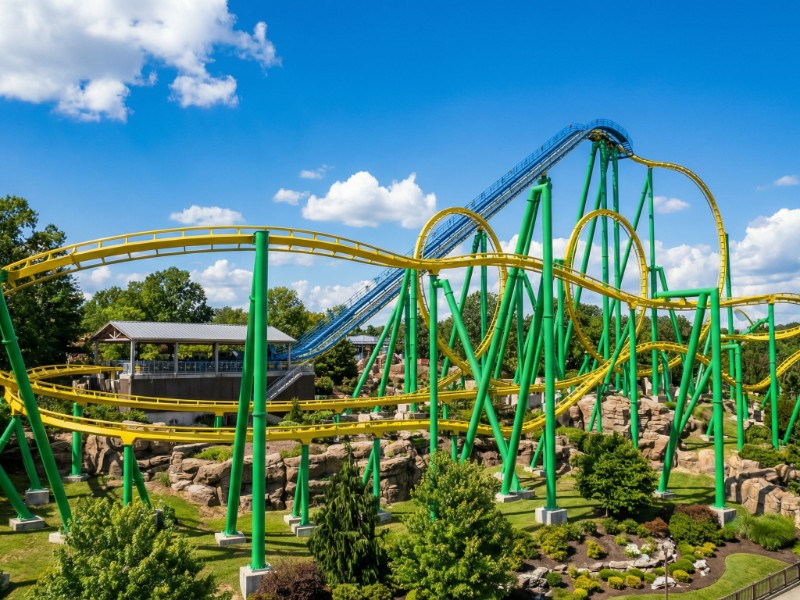
A wooden coaster uses a laminated timber track and a timber support structure; a hybrid uses a steel track on a timber or steel structure. The cost structure differs from steel in two ways. First, civil and structural work is a larger share of capital cost because the structure is extensive and foundation-intensive. Second, the maintenance profile is continuous rather than campaign-based: timber is inspected for cracking, fastener tightness and track alignment on a scheduled basis, and track sections are replaced over the asset life.
Fewer wooden coasters are built now for procurement reasons rather than ride-quality reasons. The skilled labour to erect and maintain timber structures is less widely available, the maintenance programme requires permanent in-house capability, and the capital schedule is harder to compress. A hybrid removes some timber maintenance from the running surface but keeps the structural inspection regime. Buyers should request a five-year maintenance plan with labour hours and parts categories, and should confirm the design basis against the standard your market requires, confirmed per project.
Launch coasters
Launch coasters replace or supplement the lift hill with a powered acceleration section. Three drive families are common:
- Chain lift: a mechanical lift to a high point, then gravity. Lowest control complexity, but the lift is a slow section and the height defines the energy budget.
- LSM (linear synchronous motor): magnetic acceleration with electronic control. Programmable launch profiles, lower mechanical wear on the drive, and a significant electrical supply requirement at the launch zone.
- Hydraulic launch: stored hydraulic energy released through a catch car and cable. High initial acceleration, but more mechanical systems to maintain and a larger plant room.
Power implications are a procurement item. LSM and hydraulic launches draw high instantaneous power, so the site needs a supply study, transformer sizing and often demand management. Throughput trade-offs follow from the launch cycle: a launch that must reset and recharge between trains limits dispatch interval, so the number of trains and the block layout must be matched to the launch system, not chosen independently.
Suspended and inverted coasters
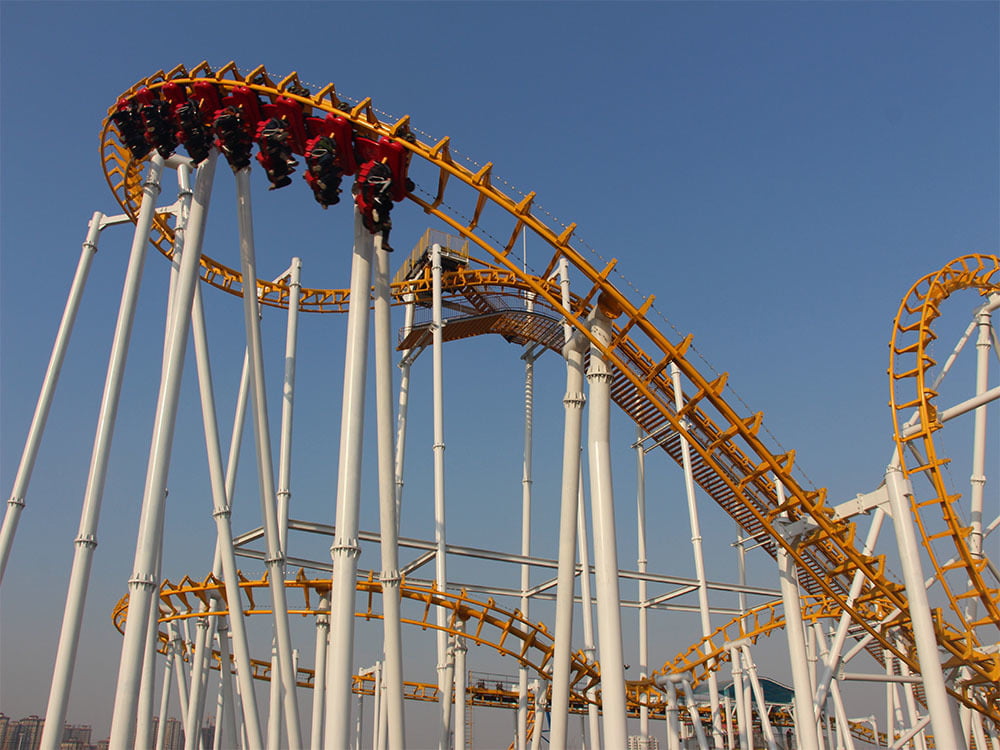
On an inverted coaster the train runs beneath the track with riders seated upright and legs free; on a suspended coaster the car hangs and can swing through turns. Both free the track of structure above the rider, which changes clearance planning: the envelope below the track must be kept clear of paths, landscaping and queue lines, and the swing or leg envelope adds to the swept volume.
Loading is a distinct operation. Restraints close from above or from the side depending on the design, and staff must check each rider's position and restraint lock before dispatch. Ride feel is characterised by exposure and, on suspended designs, lateral swing; this affects guest suitability signage and height restrictions. Ask for the swept-envelope drawing and the restraint check procedure as part of the technical file.
Flying coasters
A flying coaster positions riders face-down beneath the track, held by a restraint system that carries the body in a prone position. Restraint complexity is higher than on a sit-down coaster: the system must secure the torso and legs, and the loading procedure must confirm the rider is correctly positioned before the car is rotated or dispatched. Training requirements are correspondingly longer for operators, with competency assessment on restraint verification and evacuation from a prone position.
Throughput is affected by loading time. Prone loading and checking take longer per rider than upright seating, so the dispatch interval is longer for the same train capacity. Plan the station layout with adequate loading and checking positions, and model throughput on the measured loading time rather than on seat count alone.
How to choose by site, target guest and budget band
Selecting by ride type first tends to produce a layout that fights the site. Work in this order: site constraints (plot shape, soil, flood level, noise boundary), target guest (height band, thrill tolerance, family mix), then budget band including civil works, plant and five-year operating cost. The ride type follows from those inputs.
- Constrained urban site: compact steel sit-down or inverted layout; check column positions and noise at the boundary.
- Large greenfield site with family focus: steel sit-down or suspended; lower restraint complexity and faster loading.
- Destination park with high thrill positioning: launch or flying; confirm power supply and loading-time model before committing.
- Heritage or landscape-led park: wooden or hybrid; confirm in-house maintenance capability and timber supply.
For a shortlist of current models, see roller coasters for sale, and for dimensional and technical data see the specifications page. Confirm every design basis against the standard your market requires, confirmed per project.
| Type | Typical height band | Throughput behaviour | Main operating cost |
|---|---|---|---|
| Steel sit-down | Mid to tall, layout-dependent | Set by block layout and dispatch interval | Track and train inspection, wheel and bearing replacement |
| Wooden / hybrid | Low to mid | Longer dispatch, weather-sensitive | Continuous timber inspection and track replacement |
| Launch (LSM / hydraulic) | Low to tall | Limited by launch reset and recharge | Electrical demand, drive and control maintenance |
| Suspended / inverted | Mid | Restraint check time per rider | Restraint mechanism service, evacuation training |
| Flying | Mid to tall | Longer loading and checking time | Restraint system service, operator competency programme |
Next step
Prepare a site brief with plot dimensions, soil report, power supply capacity, target guest height band and budget band including civil and five-year operating cost. Send it to the supplier and ask for a concept layout, foundation load drawing, restraint and evacuation procedure, and a maintenance plan. ZhipaoRides can respond to that brief with a type recommendation and technical documentation; the standard your market requires is confirmed per project.