
Importing an amusement ride from China is a document-and-logistics exercise as much as an equipment purchase. The ride is built to your site drawings, packed into containers according to a loading plan, cleared through your customs regime, and then installed by a crew that can only start when foundations, power and access are ready. Most delays on these projects come from mismatched paperwork, underestimated destination charges, or site readiness gaps — not from the ride itself. This guide sets out what a procurement team should control at each stage, from deposit to opening day.
The document set
Every shipment needs a document set that agrees with itself. A single discrepancy — a weight that differs between the packing list and the bill of lading, a model name spelled two ways — can hold a container at destination for days. Build the set before the container is sealed, not after.
| Document | Issued by | What it proves | Common mistake |
|---|---|---|---|
| Commercial invoice | Supplier | Value, terms of sale, buyer and seller, Incoterm | Value or Incoterm differs from the letter of credit or the customs declaration |
| Packing list | Supplier | What is in each package, weights, dimensions, marks | Package count or weight does not match the container load or the bill of lading |
| Bill of lading | Carrier or freight forwarder | Contract of carriage and title to the goods | Consignee details wrong; original vs telex release not agreed in advance |
| Certificate of origin | Chamber of commerce or authorised body | Country of manufacture, for duty and trade-agreement treatment | Requested too late to qualify for a preferential tariff |
| Fumigation / ISPM 15 | Treatment provider, with mark on wood | Wood packaging has been treated to the ISPM 15 standard | Untreated crates or dunnage; missing or illegible IPPC mark |
| Insurance certificate | Insurer | Cover for the cargo during the insured leg | Cover starts after loading, leaving the inland leg or port storage uninsured |
What goes wrong, document by document
- Commercial invoice: the declared value must match what your bank and customs see. If you are financing through a letter of credit, every line must match the credit terms exactly.
- Packing list: this is the document your site team will use to check receipts. Ask for package-level detail — crate number, contents, weight — so a missing crate is visible on day one.
- Bill of lading: decide early whether you need original bills or a telex release. Original bills that arrive by courier after the vessel can add days of port storage.
- Certificate of origin: confirm with your customs broker which form your destination market accepts, and request it at order stage.
- Fumigation / ISPM 15: wood packaging must carry the correct mark. Crates that fail inspection at destination can be treated, returned or destroyed at your cost.
- Insurance: agree the cover period with your insurer so it matches the Incoterm you chose. Under FOB, your cover should begin when the goods are loaded, not when they arrive.
Incoterms in practice: FOB vs CIF vs DAP
The Incoterm decides where your responsibility starts and who pays for what. For a first import, the choice usually comes down to how much of the freight chain you want to control.
- FOB (Free On Board): the supplier delivers to the named Chinese port and clears export. You appoint the forwarder, pay ocean freight, insurance and destination charges. This gives you visibility of freight cost and control of the carrier, but requires a forwarder you trust.
- CIF (Cost, Insurance and Freight): the supplier pays freight and insurance to your destination port. Convenient, but the insurance cover and carrier are chosen by the supplier, and the freight cost is embedded in the price. You still handle destination clearance and inland transport.
- DAP (Delivered At Place): the supplier delivers to a named address — usually your site — with import clearance and duties typically on you unless agreed otherwise. This shifts most of the logistics burden to the supplier, but you lose visibility of the freight cost and have less control over the carrier and routing.
For multi-container ride shipments, FOB with your own forwarder is the most common arrangement because it keeps freight, insurance and destination handling under one party you appointed. Whichever term you choose, write it into the contract with the named port or address, and make sure the commercial invoice states the same term.
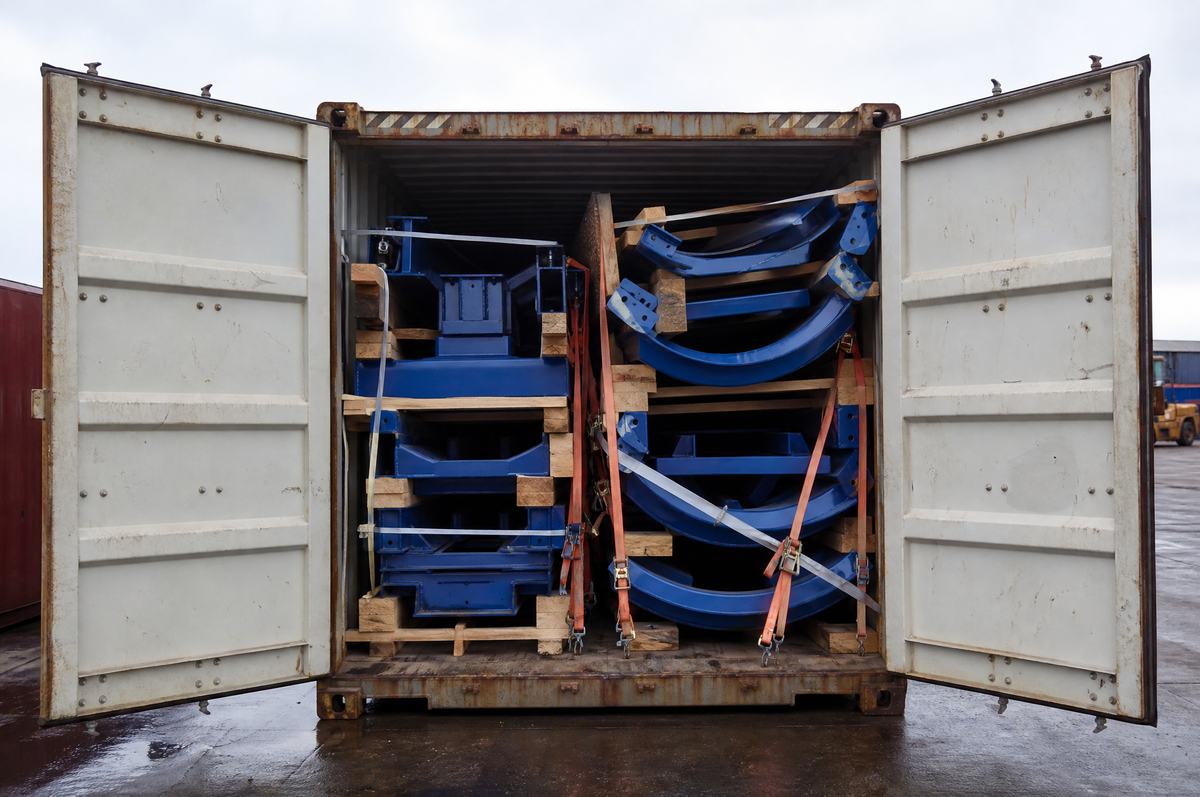
Container planning: how component size drives container count and site storage
Container count is driven by the longest, widest and heaviest components, not by total tonnage. Track sections, support columns, the station structure and the electrical cabinets each impose their own limits. A 40 ft container has a fixed internal length and a fixed door opening; a track section that exceeds either needs a different packing approach or a different container type.
Ask the supplier for a loading plan before production is complete. It should show, per container, the package list, weights, dimensions and the lifting points. From that plan you can work out:
- How many containers and what type — standard dry, high-cube, or open-top for oversize items.
- How much site storage you need — crates that cannot be opened until foundations are signed off will occupy space for weeks.
- What lifting equipment is required on arrival — a container of track sections may need a crane or telehandler, not a forklift.
- What can be assembled on the ground — some components are easier to pre-assemble in the staging area than at height.
Plan storage before the first container arrives. Crates left on open ground for weeks are exposed to rain, dust and theft, and a damaged electrical cabinet can delay commissioning regardless of how well the ride was built. For ride-specific dimensional data, see the specifications pages.

Customs and destination charges: what is usually underestimated
Buyers typically budget for duty and forget the rest. The charges that most often surprise first-time importers are:
- Port and terminal handling — charged per container, and they accumulate daily if clearance is slow.
- Demurrage and detention — free time at destination is limited; a documentation error can consume it.
- Customs brokerage — fees for clearance, plus the cost of any inspection.
- Inland transport — moving containers from port to site, including permits for oversize loads.
- Unloading at site — crane or telehandler hire, which may need booking weeks ahead.
- Taxes and levies — VAT or equivalent, plus any destination-market conformity assessment required by your regulator.
Ask your broker for a landed-cost estimate before you sign the supply contract, and confirm which conformity documents your destination market requires. Standards are confirmed per project against the standards required by your destination market.
Site handover: what must be ready before the installation crew arrives
The installation crew's schedule is fixed once flights and visas are booked. If the site is not ready, the crew waits — and waiting time is usually chargeable. Before the crew arrives, confirm:
- Foundations — poured, cured and signed off against the supplier's foundation drawings, with anchor bolt positions verified.
- Power — the supply capacity and connection point agreed, with the cable route prepared.
- Access — a route for containers and lifting equipment to reach the installation area, with permits in place.
- Storage and laydown area — fenced, drained and large enough for the crates still to be opened.
- Lifting equipment — crane or telehandler booked for the dates the crew needs it.
- Local labour — helpers for moving components, as agreed in the installation scope.
- Documents — drawings, manuals and the packing list on site, in the language the crew and your team use.
Walk the site with the supplier's installation lead by video before the crew departs. A one-hour call at that point is cheaper than a week of standby.
A realistic timeline from deposit to opening day
Timelines vary by ride type and by how quickly approvals move in your market, but a typical sequence looks like this:
- Weeks 0–2: contract signed, deposit paid, foundation drawings issued.
- Weeks 2–6: foundations designed and approved locally; site works begin.
- Months 2–6: manufacturing, with factory acceptance checks before packing.
- Month 6–7: loading plan confirmed, containers packed, documents issued.
- Month 7–9: ocean freight and destination clearance.
- Month 9–10: installation, commissioning and staff training.
- Month 10–11: inspection against the standards required by your destination market, then opening.
Compress this only where the site works and the approvals genuinely allow it. The most common cause of slippage is foundations starting late, not manufacturing.
Next step
If you are evaluating a coaster for your park, review the roller coaster range and request the loading plan and document checklist for the model you are considering. Both are issued before contract signature so your forwarder and broker can quote against real data.