
Buying an amusement ride for an Indonesian park is an import project before it is a construction project. The importer of record must hold the correct customs identity, the ride must arrive with documentation that matches the standards required by your market, confirmed per project, and the site must be surveyed for soil, drainage, monsoon load and coastal salt before the foundation drawing is fixed. Power quality and humidity then decide how the ride is specified, not how it is marketed. This guide sets out the sequence a park or developer should follow when sourcing from an overseas amusement rides supplier for Indonesia.
1. Import route: what the importer of record needs before the container ships
The importer of record is the party legally responsible for the entry declaration, duty and tax payment, and for holding the ride to Indonesian import rules. Confirm who that party is before the purchase order is signed, because the answer changes the shipping documents.
- Customs identity. An Indonesian legal entity with a valid tax identity and the import licences appropriate to the goods classification. A foreign buyer cannot act as importer of record for a ride installed in Indonesia.
- HS classification agreed in writing. Ride structures, electrical cabinets, control systems and spare parts may not fall under one heading. Classification drives duty and tax treatment, so agree it with your customs broker before shipment, not after arrival.
- Documents that must match the packing list. Commercial invoice, packing list, bill of lading, certificate of origin, and the technical file. Discrepancies between the invoice description and the technical file are a common cause of hold at port.
- Pre-shipment inspection. Where your route requires inspection before loading, book it early. The container should not sail with an open inspection item.
- Port and inland route. Confirm the discharge port, the inland haulage permit for an abnormal load, and the crane capacity at the site. A Ferris wheel or coaster section that cannot leave the port yard is a cost event, not a delay.
Ask the supplier for the shipping documentation package as a defined deliverable, listed line by line in the contract, with the responsible party named for each item.
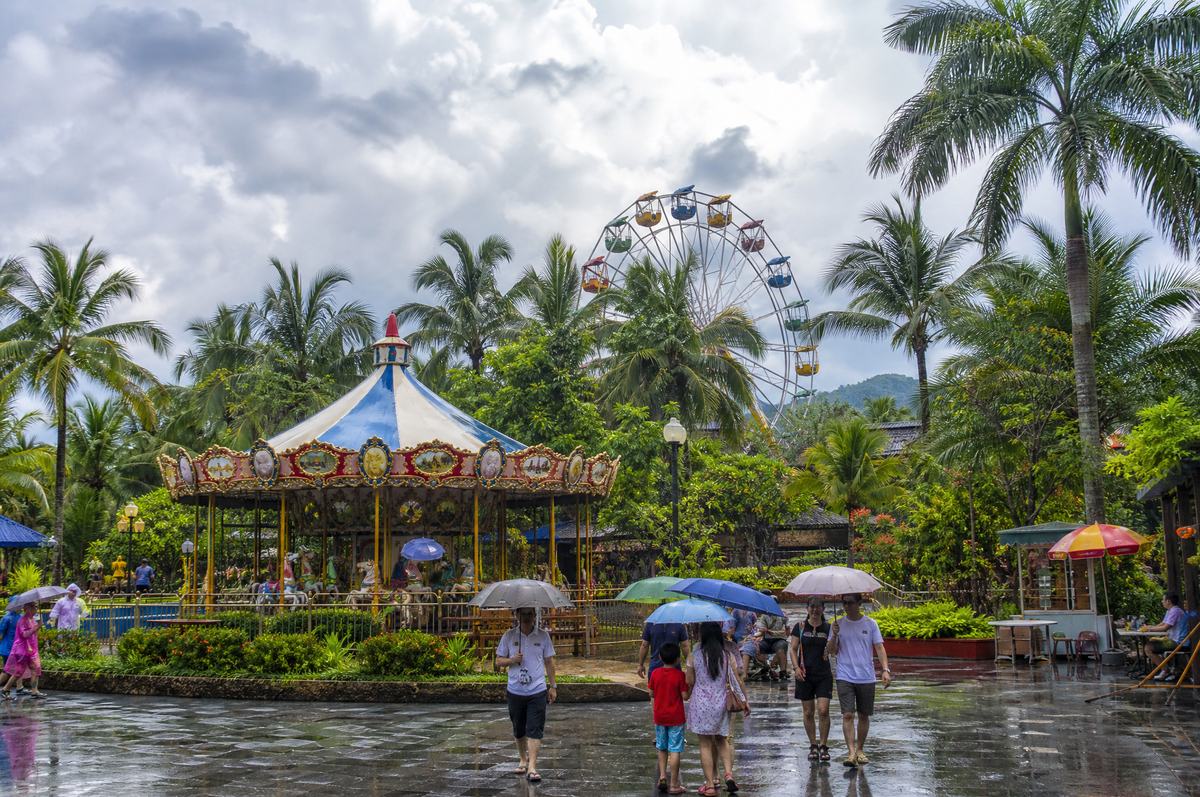
2. Local content and permit realities that affect the timeline
Permitting is the schedule risk that most often exceeds the shipping schedule. Build the timeline backwards from the opening date and treat each permit as a dependency, not a formality.
- Business and investment registration. The operating entity must be registered for the activity before ride permits can be issued in its name.
- Land and building approval. Site plan, building permit and the structural submission for the ride foundation are reviewed locally. Foundation drawings must be complete, which means the soil survey comes first.
- Ride registration and inspection. Ride installation and operation are subject to inspection against the standards required by your market, confirmed per project. Agree with the supplier which documents, calculations and test records they provide and which the local installer provides.
- Local content expectations. Civil works, foundations, queue lines, landscaping, electrical supply to the point of connection and much of the installation labour are normally sourced locally. Plan the split between imported ride equipment and locally supplied scope in the contract, because it affects both cost and the permit narrative.
- Installer competence. Name the installation contractor early and confirm the supervision arrangement with the manufacturer. Mechanical completion, electrical commissioning and the load test sequence should be written into one schedule.
3. Site conditions: soil, drainage, monsoon and coastal salt
Indonesian sites vary from volcanic upland to reclaimed coastal plain, and the foundation design must follow the actual ground. Commission a geotechnical survey at each ride footprint, not one survey for the whole park, and give the report to the ride manufacturer before foundation drawings are issued.
- Soil. Bearing capacity, settlement behaviour and groundwater level determine whether the structure sits on spread footings or needs ground improvement. Do not let a foundation design be issued against assumed soil.
- Drainage. Monsoon rainfall is intense and short. Design site drainage so that water does not pond at the ride base, at cable pits, at lift pits or at the base of a wheel. Confirm finished floor levels against the local flood record.
- Coastal salt. Within the coastal belt, airborne chloride accelerates corrosion on exposed steel, fasteners and electrical enclosures. State the distance to the shoreline in the enquiry so the corrosion protection specification can be set for that exposure.
- Wind and lightning. Confirm the design wind speed for the site and the lightning protection arrangement for tall structures such as a Ferris wheel or drop tower.
For tall structures, the foundation and wind submission is the long-lead engineering item. Review the Ferris wheel range against your site survey before committing to a height.
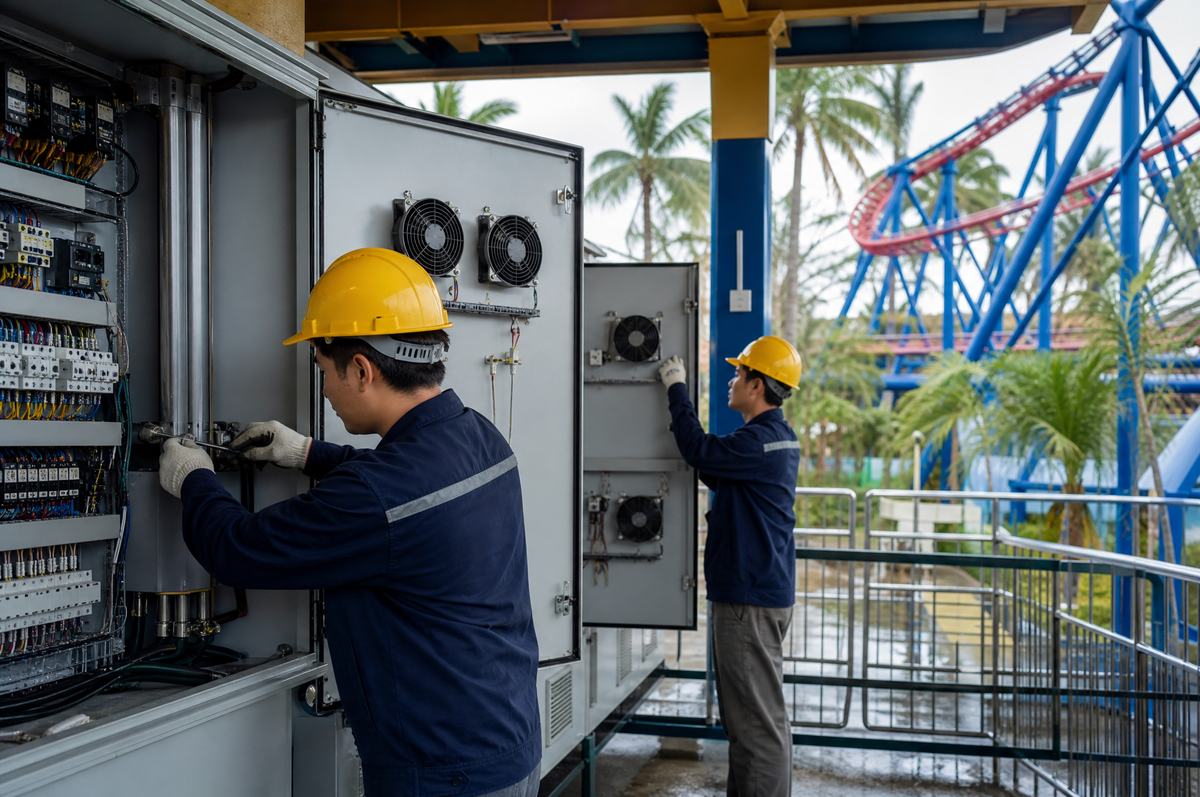
4. Power quality: voltage stability, earthing and generator backup
Ride control systems are sensitive to voltage variation, phase imbalance and poor earthing. On many Indonesian sites the supply is adequate on average but unstable at the edges, and the ride is affected at the edges.
- Supply study. Record the actual voltage at the point of connection over a full week, including the evening peak, before specifying the drive and control package. Give the record to the manufacturer.
- Earthing. Confirm the earthing arrangement and measured resistance at the ride, and separate ride earthing from the park lighting and building earth where the local code requires it.
- Generator backup. Define what the generator must carry: safe ride evacuation and restraint release, or full ride operation. These are different generator sizes and different transfer arrangements.
- Protection. Specify surge protection and phase-failure protection at the ride distribution board. Tropical lightning makes this a maintenance decision.
5. Humidity and corrosion: what changes in the specification
Relative humidity near saturation for much of the year changes the enclosure, the coating and the maintenance interval. Raise these points in the enquiry rather than after delivery.
- Enclosures. Specify ingress protection and anti-condensation measures for control cabinets, and confirm whether cabinet cooling or heating is required for the site.
- Corrosion protection. State the coastal or inland exposure class so surface preparation and coating system are set for that environment, including fasteners and small components.
- Lubrication and seals. Confirm the lubricant and seal specification for high humidity, and the recommended inspection interval for bearings and moving joints.
- Spares. Include a first-year spares list agreed with the manufacturer, covering the items most affected by humidity and salt.
The technical file should state these specifications explicitly. Review the published specifications and request the project-specific version for your site.
6. Throughput planning for family-oriented parks
Indonesian park development is weighted toward family audiences, so hourly capacity per square metre of footprint usually matters more than ride intensity. Plan throughput from the guest mix, not from the ride catalogue.
- Cycle time including load and unload. Ask for the cycle time with a realistic load and unload allowance for families with children, not the theoretical dispatch interval.
- Queue footprint. A high-capacity ride with an undersized queue creates congestion elsewhere. Size the queue for the peak hour.
- Mix. Combine carousels, flume rides and family coasters to hold guests in the park, with one taller signature structure such as a Ferris wheel or drop tower as the skyline anchor.
- Operating window. Plan maintenance windows around the monsoon pattern and school holiday peaks.
Requirement | Why it matters in Indonesia | What to confirm early
| Requirement | Why it matters in Indonesia | What to confirm early |
|---|---|---|
| Importer of record | Entry declaration, duty and tax sit with an Indonesian entity | Named entity, tax identity, import licences |
| HS classification | Drives duty and tax treatment across mixed shipments | Classification agreed with customs broker |
| Geotechnical survey | Soil and groundwater vary widely between sites | Report issued per ride footprint before foundation design |
| Drainage and flood level | Monsoon intensity and local flood record | Finished floor levels and pit drainage |
| Corrosion exposure | Coastal chloride and year-round humidity | Distance to shoreline stated in enquiry |
| Power quality | Voltage variation and phase imbalance affect controls | One-week voltage record at point of connection |
| Generator scope | Evacuation versus full operation are different sizes | Required function and transfer arrangement |
| Permits and inspection | Registration and inspection gate the opening date | Document split between supplier and installer |
| Throughput | Family mix rewards capacity per square metre | Cycle time with realistic load and unload |
Next step
Send ZhipaoRides your site location, distance to shoreline, geotechnical summary, one-week power record and target opening date. The reply will be a project-specific specification and documentation list, with the standards required by your market confirmed per project, so your importer of record and installation contractor can plan against fixed inputs.