Why family coaster throughput matters before you sign
Throughput is the number of riders a coaster moves per hour. For a family coaster, it often decides whether the ride pays for itself. A small park with 1,500 daily visitors and a peak-hour crowd of 400 people will see a queue build quickly if the coaster handles only 400 riders per hour. A larger park may need 800 or more per hour from the same ride footprint.
Two things set that number: how many trains run on the track, and how the station is laid out. Track length and lift height matter, but they are fixed early. Train count and station design are the variables a buyer can still change during specification. This article explains how they work together, so you can give a supplier the right inputs for a scoped quotation.
ZhipaoRides builds family coasters at its plant in Xingtai, Hebei, and configures train count and station layout per order. The points below apply to any supplier, but they are the questions we ask every buyer before quoting.
The throughput formula, in plain terms
Hourly capacity is the number of riders per train multiplied by the number of dispatches per hour. Dispatches per hour is 3,600 divided by the average interval between train departures, measured in seconds. If a train seats 20 riders and the station dispatches one every 60 seconds, capacity is 20 × 60 = 1,200 riders per hour. If the interval stretches to 90 seconds, capacity drops to 800.
That interval is where most projects lose capacity. It includes loading, restraint checks, platform clearance and the time the control system needs to confirm the track is clear. A well-run station can hold a 60–75 second interval on a family coaster. A poorly laid out one drifts past 120 seconds, and the ride never reaches its rated capacity.
Two cautions when reading supplier capacity figures. First, ask whether the number assumes a full train; empty seats reduce real throughput. Second, ask what dispatch interval the figure assumes. A capacity quoted without an interval is not a commitment.
How train count changes capacity
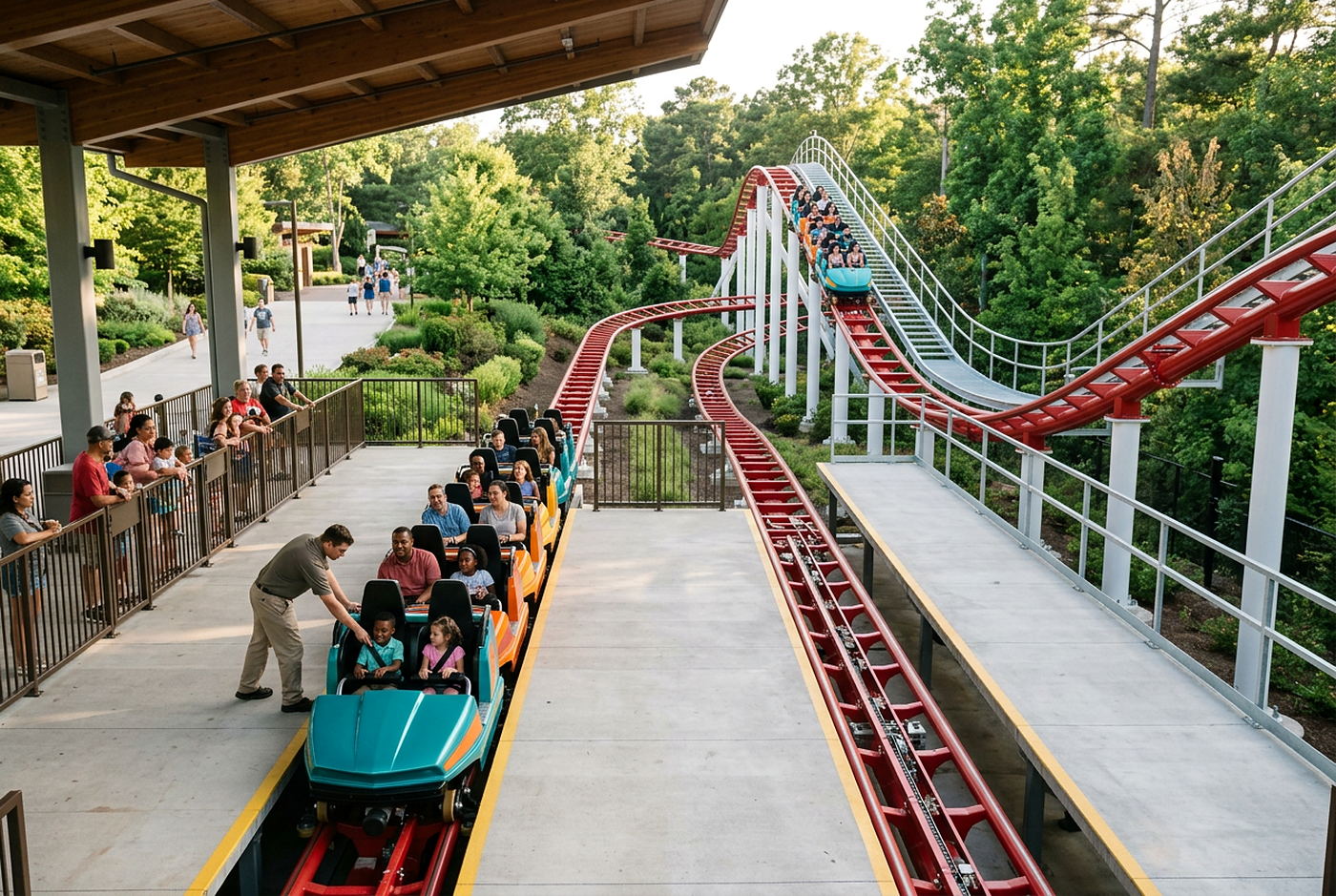
Adding trains raises capacity only if the station can turn them around fast enough and the track has somewhere for them to wait. On a family coaster, three configurations are common:
- Single train. The train must complete the circuit and return before the next dispatch. Capacity is limited by cycle time, typically 90–150 seconds on a family layout. Suitable for low-traffic parks or as a secondary ride.
- Two trains. One train loads while the other runs. With a double station or a holding brake before the platform, the interval can fall to 45–60 seconds. This is the most common choice for parks expecting steady family traffic.
- Three trains. One loads, one runs, one waits on a block brake. This supports intervals near 40 seconds, but only if the block system and station are designed for it. It adds cost and maintenance for a gain that many family parks do not need.
Each additional train adds rolling stock, braking hardware and control logic. It also adds daily inspection time. The right count is the lowest one that meets your peak-hour target with some margin, not the highest one you can afford.
Block sections set a hard ceiling. A coaster can never have more trains than it has safe stopping points. On a short family layout, the practical limit may be two trains regardless of station size. Ask the supplier to show the block layout before agreeing to a train count.
Station design: where throughput is won or lost
The station is the bottleneck on most family coasters. Four design choices matter most:
Platform length and train position
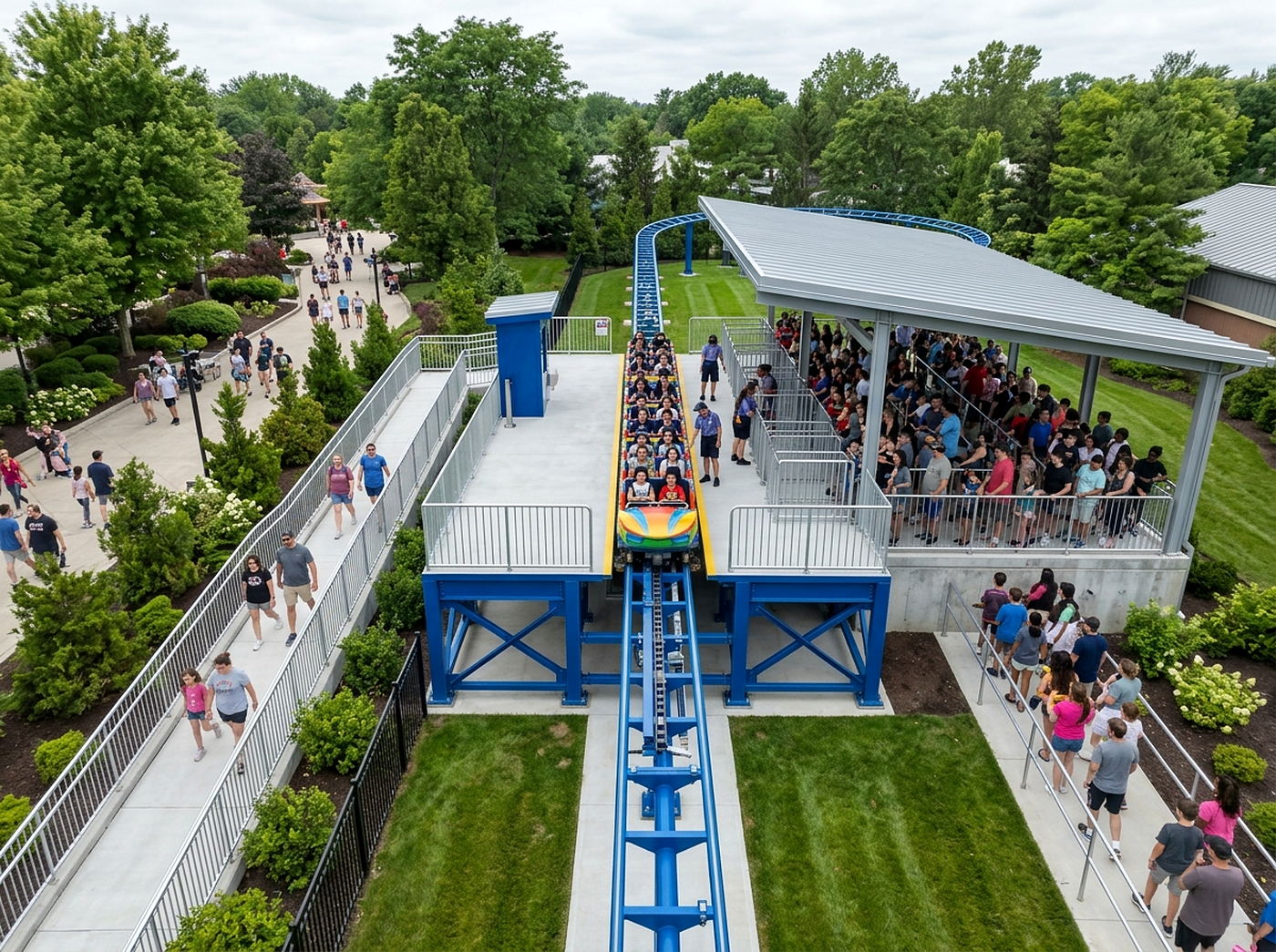
A platform long enough to hold the whole train lets all rows load at once. If the train sits partly outside the platform, those rows load slower or not at all. Confirm the platform length against the train length in the layout drawing.
Single or double station
A double station lets one train load while another unloads, cutting the interval. It costs more track and structure, but on a busy family coaster it is often cheaper than a second ride.
Restraint type and checking
Simple lap bars with a single check are faster to verify than complex harnesses. On a family coaster, restraint choice affects both dispatch time and the minimum height requirement, so decide it with your target audience in mind.
Queue and exit flow
Guests must clear the platform before the next train arrives. Separate entry and exit paths, a gate that opens only when the platform is clear, and a queue that holds at least two trainloads keep the interval stable. A queue that spills onto the platform slows every dispatch.
Matching throughput to your park
Work backwards from attendance. Estimate peak-hour riders for the coaster, not daily attendance. A useful starting point is the number of visitors in your busiest hour who are tall enough and willing to ride. Compare that with the capacity figures above, then add a margin of 20–30 percent for breakdowns, weather and slow dispatches.
Also check the ride against your park's mix. A family coaster with 800 riders per hour may be enough if it shares the load with other family rides. If it is the only coaster in the park, plan higher. The family roller coaster product page lists configurations by train count and layout so you can compare options side by side.
Maintenance capacity matters too. More trains mean more daily checks and more spare parts. A park with a small maintenance team should weigh a two-train layout with a well-designed station against a three-train layout that demands more attention.
Questions to ask before you request a quotation
Give a supplier these answers and the quotation will be scoped rather than generic:
- Expected peak-hour riders for the coaster and the daily attendance figure behind it.
- Available site length and width, including station and queue area.
- Target dispatch interval and whether it assumes a full train.
- Preferred train count and whether the layout has block sections to support it.
- Restraint type and the minimum height you want to set.
- Local power supply and any site constraints such as wind or noise limits.
With those inputs, a supplier can propose a train count, station arrangement and block layout that meet the target. ZhipaoRides quotes family coasters with the capacity calculation shown openly, including the dispatch interval assumed. You can review the family roller coaster for sale page for the model range, then send your site and attendance figures for a scoped quotation.
Next step
Throughput is a design decision, not a spec-sheet number. Decide your peak-hour target, choose the lowest train count that meets it, and design the station around a realistic dispatch interval. Then request a quotation that states the interval and the riders per train behind its capacity figure. That single step separates a workable budget from an optimistic one.