
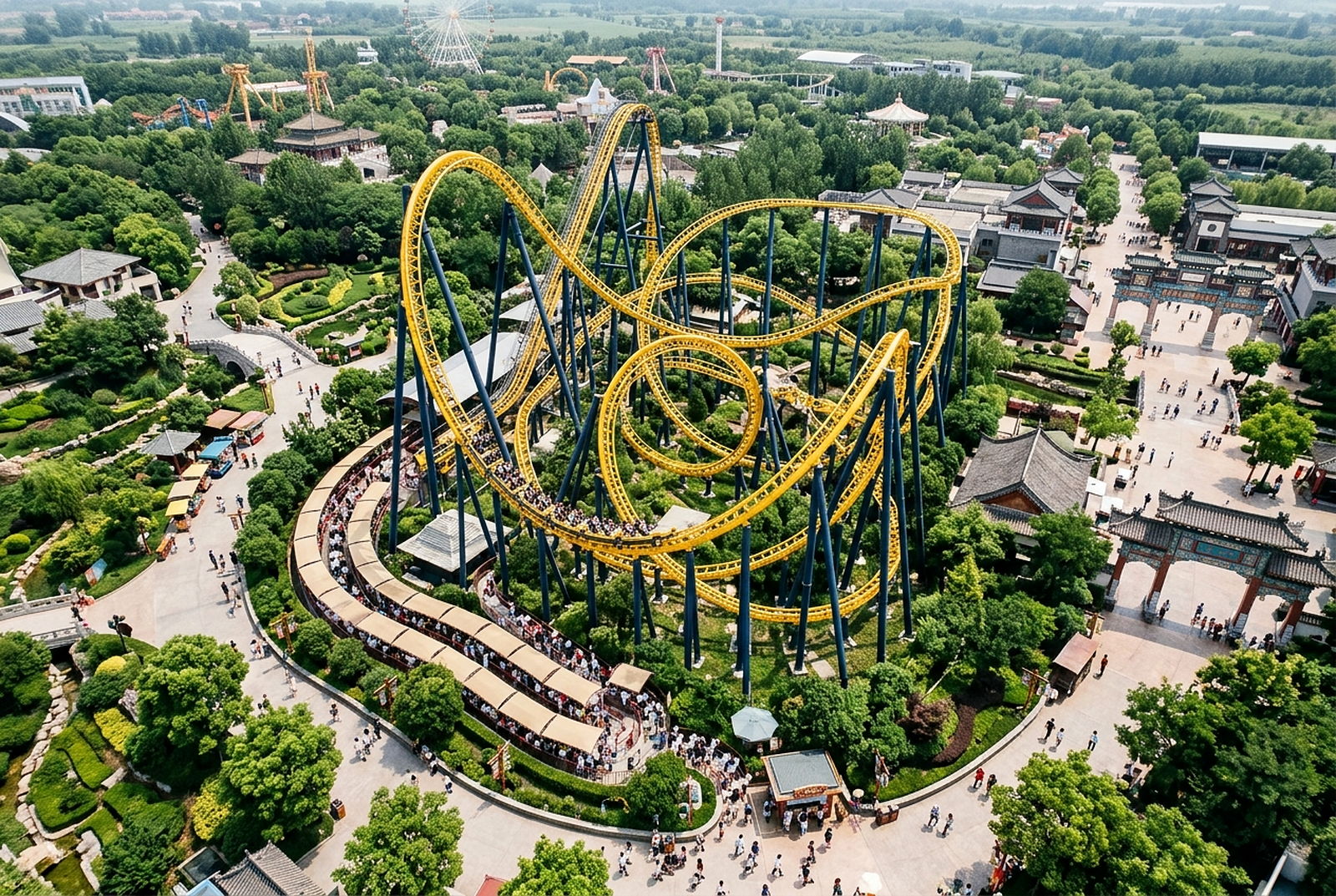
Every park buyer eventually asks the same question in a different order: how much thrill can I fit on the land I actually own? This ranking uses one measurable ratio to answer it — inversions per hectare — and then explains exactly what that ratio ignores.
How the ranking is calculated
The metric is simple. Take the number of inversions on the circuit and divide by the land the ride occupies, including its queue, station and exclusion zone. A layout with four inversions on 0.6 ha scores 6.7; a layout with one inversion on 1.4 ha scores 0.7.
It is a density measure, not a quality measure. A park with 20 hectares does not need density. A park with two hectares does, and for those buyers this ratio is closer to the real decision than any marketing claim about speed.
Figures below are typical layout classes, not individual products. Treat them as design geometry, not as a specification of any one supplier.
The ranking
| Rank | Layout class | Typical footprint | Inversions | Inversions / ha |
|---|---|---|---|---|
| 1 | Compact multi-inversion (4+ loops) | 0.5–0.7 ha | 4 | ≈ 6.0–7.5 |
| 2 | Compact launch coaster | 0.7–1.0 ha | 2–3 | ≈ 2.5–4.0 |
| 3 | Wild-mouse / spinner | 0.4–0.7 ha | 0–1 | ≈ 0–2.0 |
| 4 | Family coaster, elevated | 0.8–1.2 ha | 0–1 | ≈ 0–1.2 |
| 5 | Inverted / suspended family | 1.0–1.5 ha | 1–2 | ≈ 0.7–2.0 |
| 6 | Hyper / long out-and-back | 2.5–4.0 ha | 0–2 | ≈ 0–0.8 |
Why the top three score the way they do
1. Compact multi-inversion
Four inversions in a 480–520 m circuit is the densest arrangement that still gives a comfortable ride envelope. The loops stack vertically rather than spreading horizontally, so the land is used twice: once at ground level for the queue and once in the air for the track.
Our Four-Loop Roller Coaster is 480 m with four inversions, and the New 4-Loop is 510 m at 25.6 m height and 74.1 km/h. Both fit inside a plot smaller than a football pitch's exclusion zone.
2. Compact launch
A launch removes the lift hill, which removes the longest single element in the layout. That frees roughly 30–40 m of ground length, which is why launch layouts score well — but the launch section itself needs a straight run and a power supply, and that is what keeps them below the multi-loop class.
3. Wild mouse and spinner
Almost no inversions, but very small footprints. The ratio is moderate because the denominator is small, not because the numerator is large. If your goal is visual impact from outside the fence, this class will not deliver it.
What the ratio hides
- Throughput. Two rides with identical density can differ by 300 riders per hour based on train count and station design.
- Height restriction. A lower restriction widens the addressable audience more than an extra inversion does.
- Maintenance load. Every inversion adds wheel and restraint inspection time — a real operating cost, invisible in the ratio.
- Foundation cost. Dense layouts concentrate loads; the ground conditions can cost more than the density saves.
How to use this ranking
Use it to shortlist, not to choose. If you have under one hectare and want a headline attraction, the top class is the only realistic answer. If you have four hectares and a family audience, a long out-and-back at rank six may earn more per guest than four inversions on a postage stamp.
The right question is not "which scores highest" but "which score matches my land, my audience and my maintenance capacity".
Frequently asked
Does more inversions mean a better ride?
No. Inversions are a marketing number. Ride comfort, cycle time and the queue experience decide whether guests ride twice.
Can a compact layout be expanded later?
Usually not without a new circuit. Expansion means new track, new supports and a new foundation design — plan the land for the layout you want in ten years, not the one you can afford today.