
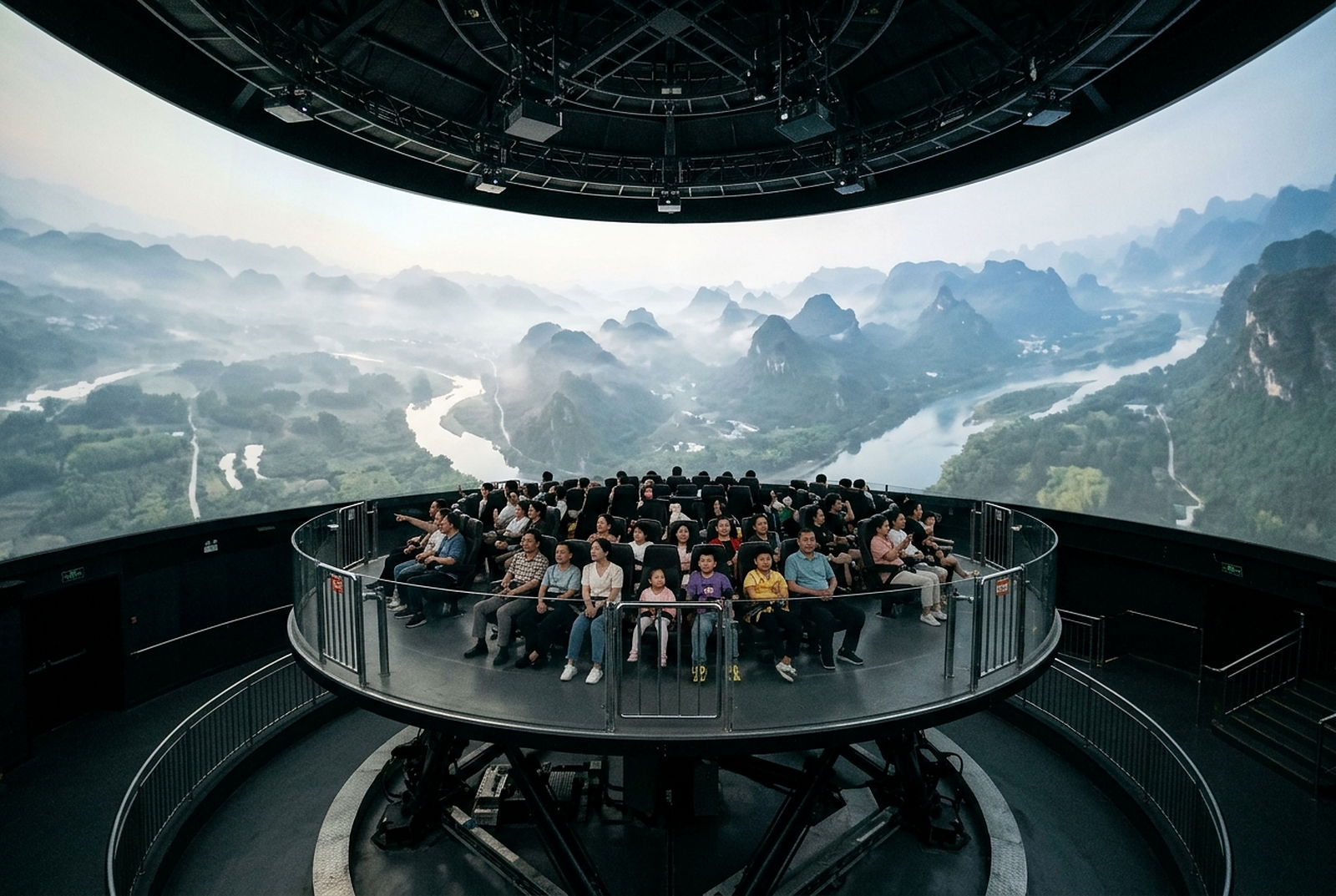
A 360° flying dome theatre is an indoor cinematic attraction in which a spherical screen forms the entire inner surface of a domed hall and guests ride on a rotating platform inside it. The ride is the screen, not the movement: the platform turns slowly so the audience faces a different part of the sphere, giving a continuous wraparound image rather than a single forward view.
At a glance
- Type: indoor cinematic ride, no outdoor structure
- Screen: full sphere or near-sphere, LED tile or projection
- Seating: circular platform, 24–60 guests per cycle
- Cycle: typically 4–8 minutes including boarding
- Footprint: the hall, not the sphere, defines the building volume
- Weather: fully indoor, operates year-round
How it works
- The sphere is the screen. The dome is lined with a continuous display surface. Guests sit inside it, so every direction of view is image — there is no "front" to face.
- The platform rotates. A circular seating platform turns slowly around the sphere's centre, so the audience faces a new section of the image without the screen having to move.
- Content is authored for the sphere. A normal film cannot be wrapped onto a sphere. The footage is produced for the format — usually aerial or underwater journeys with continuous horizontal travel.
- The hall is the machine room. Projectors or LED drivers, cooling, service walkways and the platform drive all live behind or beneath the screen surface, inside the building envelope.
- Boarding is separated from the show. Guests load from a fixed platform, the ring rotates through a pre-show position, and the cycle repeats without stopping the screen.
Specifications that matter in a quotation
| Parameter | What it controls | Typical range |
|---|---|---|
| Sphere diameter | Perceived immersion, building height | 12–20 m |
| Screen technology | Brightness, seam visibility, maintenance | LED tile or laser projection |
| Seats per cycle | Hourly throughput | 24–60 |
| Platform rotation | Show pacing | continuous, slow |
| Film length | Cycle time and throughput | 3–5 minutes |
Where a 360° dome theatre fits
It suits parks and family entertainment centres that need an all-weather anchor with controlled throughput and a compact land take — the building can be stacked into a multi-level complex because nothing protrudes.
It does not suit sites that want a skyline landmark. The attraction is invisible from outside by design: the drama is entirely interior.
What to verify before signing
- Screen maintenance access. Ask how a failed tile or projector is reached without dismantling the seating platform.
- Content ownership. Confirm whether the film is licensed, commissioned or included — and who pays for the second film.
- Cycle time, not ride time. Boarding and disembarking usually consume more time than the show itself.
- Acoustic treatment. A sphere focuses sound; without absorption the narration becomes unintelligible at the centre.
Frequently asked
Is a 360° flying dome theatre the same as a flying theatre?
No. A flying theatre uses suspended seats facing one dome wall. A 360° dome theatre places the audience inside a spherical screen and rotates the platform. The seating hardware and the content format are different.
How many guests per hour can it handle?
Throughput equals seats per cycle divided by cycle time. A 40-seat platform on a 6-minute cycle delivers about 400 guests per hour; the same platform on a 4-minute cycle delivers about 600.
Does it need daylight control?
The hall must be dark. Any glazing into the auditorium reduces contrast and makes the screen look washed out, so the building envelope matters as much as the screen specification.
What is the main ongoing cost?
Electricity for projection or LED and cooling, plus periodic content refresh. Content, not hardware, is what keeps repeat visits.
Where these theatres are built
ZhipaoRides manufactures 360 degree flying dome theaters, flying dome theaters and dark rides in a 120,000 m2 plant in Xingtai, Hebei. The ride structure, the vehicles and the scene steel are built in the same facility, so the interface between screen and ride is settled before shipping rather than on site.