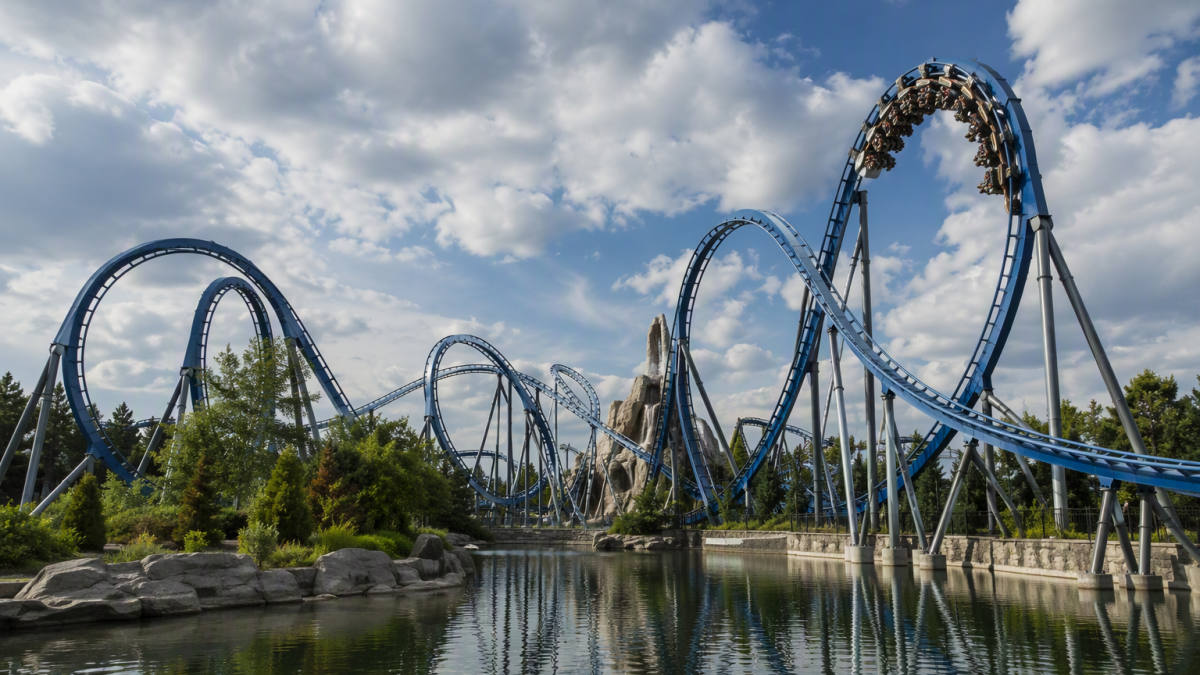
A roller coaster inversion comparison should start with a simple point: the number of loops is a design trade-off, not a score. A 4-inversion layout can serve mixed-family parks, a 6-inversion ride usually targets regional thrill parks, and a 7-inversion circuit suits destination parks with a thrill-led lineup. Each step up changes throughput, G-force exposure and maintenance load together.
Inversion Count Is a Design Trade-off, Not a Ranking
Before comparing layouts, buyers need a common definition. An inversion is any element that rotates riders through 360 degrees or more relative to the track: a vertical loop, a zero-G roll, a corkscrew, a dive loop or an inclined loop. Counting conventions vary between suppliers. Some count a zero-G roll as one inversion, others count a barrel roll as two if the track twists through two full rotations. Some catalogues separate “inversions” from “rolls” entirely. When you compare quotations, ask each supplier to list the inversions element by element rather than quoting a single number.
The three configurations buyers most often evaluate differ in more than the loop count:
- 4-inversion family thrill coaster: shorter track length, lower top speed, a compact circuit and a cycle time that often sits at the shorter end of the range. It is easier to fit into a limited footprint and easier to dispatch frequently.
- 6-inversion mid-tier thrill coaster: a longer circuit with a mix of loops, rolls and airtime elements. Train speed and structural loading rise, and the layout usually needs more land and taller support structures.
- 7-inversion high-thrill layout: the longest circuit of the three, with more sustained high-speed sections and more structural load cases. It typically requires the largest footprint and the most careful block-section planning.
Each added inversion generally increases track length, structural loading and energy per cycle. That shifts capital cost, hourly capacity and maintenance burden at the same time. A 7-inversion coaster is not simply a 6-inversion coaster with one more loop; it is a different ride with a different operating profile.
Design should reference ASTM F2291 and EN 13814. These are design standards, not certifications. Whether a specific project carries CE, TÜV or another third-party certification depends on the contract and the project documentation, so confirm the certification scope per project rather than assuming it applies across a model range.
Throughput: Cycle Time, Train Count and Hourly Capacity
Throughput is where inversion count meets operations. The basic formula is:
Riders per hour = seats per train × trains in circuit ÷ cycle time (seconds) × 3600
Run the numbers and the trade-off becomes visible. A shorter 4-inversion circuit might complete a cycle in roughly 90 seconds; a longer 6- or 7-inversion layout may add 20 to 40 seconds of ride time, plus any additional lift and brake sections. If both rides run two trains of 24 seats, the shorter circuit delivers materially more riders per hour before dispatch efficiency is even considered.
Train count is not a free variable. The number of trains in circuit depends on block-section design: brake zones, lift and transfer track, station configuration and the minimum dispatch interval the control system enforces. A layout with more track can sometimes support a third train, but only if the block sections are long enough and the station can clear and reload within the dispatch interval. Adding a train to a layout that cannot separate it safely does not raise capacity.
In practice, station design and restraint-check procedures often constrain real throughput more than inversion count. A dual-station load/unload arrangement, a clear batching procedure and enough platform staff to check restraints quickly will usually do more for hourly capacity than a shorter circuit. Queue-line design and locker placement also affect dispatch intervals.
Treat any capacity figure as project-specific. Final riders-per-hour must come from the ride's own calculation, based on its layout, train configuration and dispatch assumptions, not from a generic table.
G-Force Profile: What Riders Feel at 4, 6 and 7 Inversions
G-force is the dimension riders actually feel, and it separates the three configurations more clearly than loop count alone. Three categories matter:
- Positive G: driven by loop entries, pull-outs and tight vertical transitions. Riders feel pressed into the seat.
- Negative G: driven by airtime hills and zero-G rolls. Riders feel lifted against the restraint.
- Lateral G: driven by corkscrews, helices and unbanked turns. Riders feel pushed sideways.
More inversions usually mean more sustained positive-G events across the cycle. A 7-inversion layout that strings together loops and pull-outs can accumulate rider fatigue, so the design has to manage where the high-load moments fall and how much recovery time sits between them. A 4-inversion layout has fewer such events and is easier to tune for family-thrill positioning. A 6-inversion layout sits between the two, typically mixing positive-G elements with airtime and lateral moments to keep the ride varied.
Transition radii and banking shape peak G values more than the raw inversion count. A well-designed 6-inversion coaster with generous transition radii can feel smoother and less punishing than a poorly transitioned 4-inversion ride. Smooth transitions matter more than the number of loops, and they are also easier on wheels and restraints.
G envelopes should be validated through dynamic analysis and, where required, physical testing before opening. Ask for a summary of the calculated G profile, including peak positive, negative and lateral values, and confirm how the ride's height and health restrictions were derived from that profile.
Maintenance Burden: Wheels, Restraints and Structural Inspection
Maintenance scales with speed and cycle frequency, which is why inversion count affects lifecycle cost. The wear items to budget for include:
- Running wheels, up-stop wheels and side wheels
- Restraint mechanisms, including locking and release components
- Brake components, including friction surfaces and sensors
- Chain or lift components and anti-rollback devices
Higher speed and more inversions increase wheel load and cycle frequency, which shortens replacement intervals. A 7-inversion layout running longer, faster cycles will generally consume wheels faster than a compact 4-inversion family coaster, and its restraint mechanisms see more load cycles per operating day. The exact intervals should come from the manufacturer's maintenance manual for that specific ride, not from a rule of thumb.
Inspection routines typically follow a three-tier pattern:
- Daily pre-opening checks: visual inspection of track, wheels, restraints and brakes, plus a test cycle before guests board.
- Weekly checks: torque checks on critical fasteners, wheel wear measurement and restraint function testing.
- Periodic non-destructive testing: weld and structural joint inspection at intervals set by the manufacturer and local authority.
Corrosion control matters for long-term structural maintenance, particularly at humid or coastal sites. Hot-dip galvanized structural steel is a practical measure that reduces repainting and structural touch-up work over the ride's life.
Control-system design also affects downtime. Redundant safety control systems and remote diagnostics support faster fault identification, which shortens unplanned stoppages and helps maintenance teams prepare parts before a technician arrives on site. For parks in remote locations, remote diagnostic support can reduce the need for repeated specialist visits.
Selecting the Right Inversion Count for Your Site
Match the inversion count to your target audience first. A 4-inversion layout suits mixed-family parks that need broad ridership and short queues. A 6-inversion coaster fits regional thrill parks that want a headline attraction without excluding too much of the family market. A 7-inversion layout belongs in a destination park with a thrill-led lineup, where the ride is one of several intense attractions rather than the only one.
Then weigh footprint and height restrictions. More inversions generally require more land and taller structures, and local height limits may rule out certain layouts before cost is even discussed. A compact 4-inversion circuit can fit sites where a 7-inversion layout cannot.
Consider lifecycle cost rather than capital cost alone. Over a 10-year horizon, throughput, spare parts, wheel consumption and inspection labor often outweigh the initial price difference between configurations. A ride that dispatches more riders per hour and consumes fewer wheels can be the better investment even if its capital cost is higher.
Before comparing quotations, ask each supplier for the ride's design basis, G-force analysis, maintenance schedule and spare-parts list. Manufacturers such as ZhipaoRides, based in Xingtai, Hebei, provide design, manufacturing, installation, commissioning and operator training as a single scope, which makes it easier to compare like with like across suppliers. Confirm certification scope per project in the contract, and do not assume CE or TÜV coverage applies to every model.
Procurement Checklist Before You Commit
Use this checklist to structure supplier conversations and to make quotations comparable:
- Layout and capacity: request the layout drawing, cycle time calculation and theoretical hourly capacity in writing, including the dispatch interval assumption.
- G profile and standards: ask for the G-force profile summary and the standards the design references (ASTM F2291, EN 13814).
- Maintenance planning: obtain the preventive maintenance schedule, wear-part list and recommended spare-parts stock for the first year.
- Installation scope: clarify foundation requirements, installation duration, commissioning responsibilities and operator training.
- After-sales terms: confirm warranty terms, remote diagnostic support and response times in the supply agreement.
Price should be treated as a reference range at outline stage. Final pricing depends on layout, track length, train configuration, theming, site conditions and certification scope, and must be quoted per project. A structured comparison of throughput, G profile and maintenance burden will tell you more about value than the inversion count on the brochure.