
What an annual ferris wheel maintenance budget actually covers
When you are comparing observation wheel options or preparing a capital and operating budget, the ferris wheel maintenance cost is one of the few recurring numbers that will stay with the asset for its whole service life. It is not a single line item. It is a set of scheduled tasks, consumables, spare parts and labor hours that scale with wheel diameter, number of cabins, drive configuration and how many operating days you run per year.
This article sets out the cost structure the way an engineering team would present it to a park developer: what is inspected, what is replaced on a schedule, what is replaced on condition, and where the largest uncertainties sit. It does not quote prices, because a meaningful number depends on the specific model, site and local labor rates. It does give you the framework to build a defensible annual figure and to compare supplier proposals on equal terms.
The cost structure: fixed schedule versus condition-based work
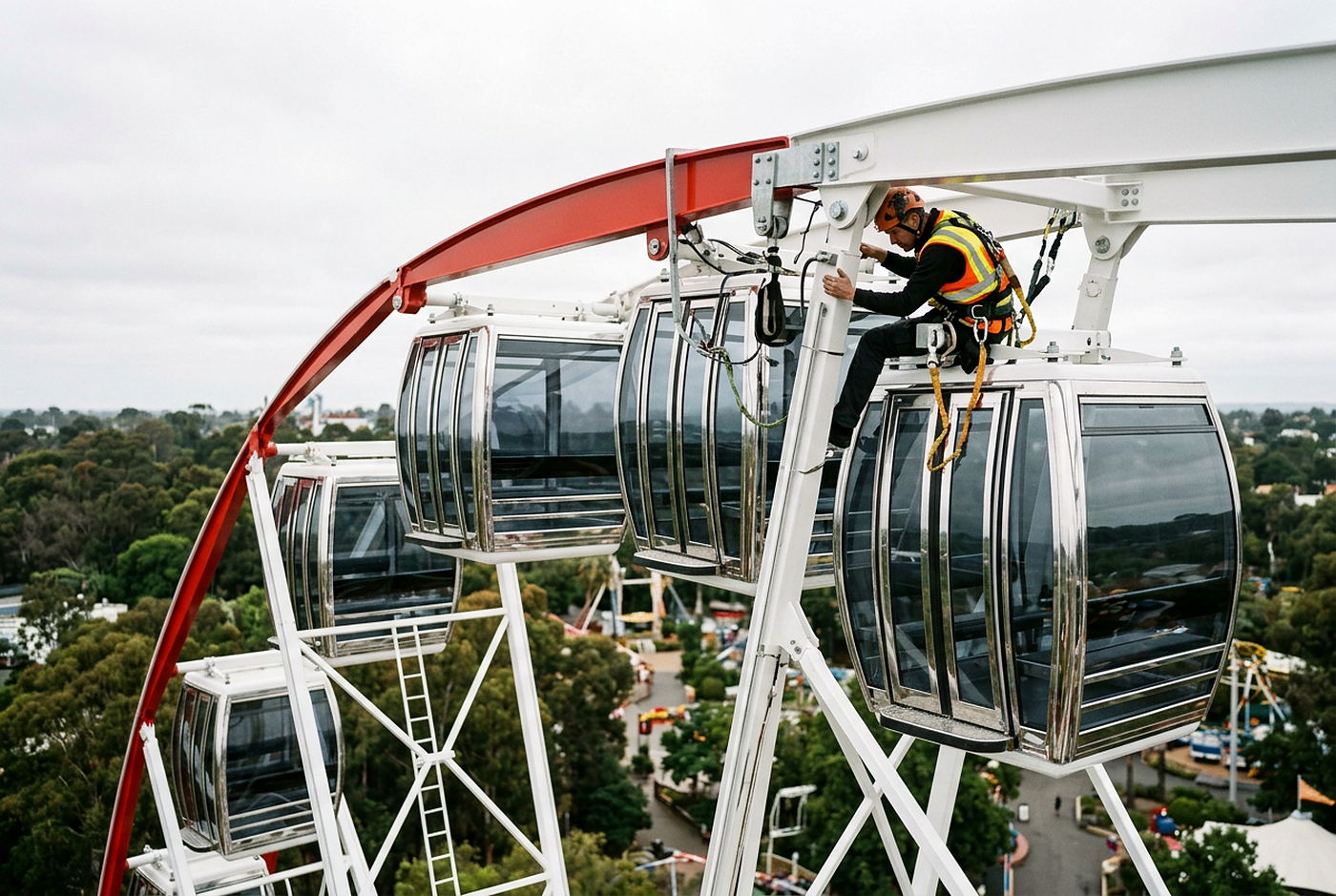
Maintenance spending on an observation wheel falls into two buckets. Fixed-schedule work happens whether or not anything is wrong: daily pre-opening checks, monthly inspections, annual NDT (non-destructive testing) of critical welds and structural connections, torque checks on cabin hangers, lubrication of the main bearing and drive train, and replacement of hydraulic hoses and seals at defined intervals. Condition-based work is triggered by inspection findings: bearing wear, cable stretch, brake pad thickness, corrosion on the rim or spokes, cabin door interlock wear, and electrical component degradation.
For budgeting, fixed-schedule work is predictable and should be treated as a baseline. Condition-based work should be carried as a contingency, typically expressed as a percentage of the baseline. The ratio between the two depends heavily on environment: a wheel in a coastal or humid climate will see more corrosion-related work than one in a dry inland site, and a wheel that runs 360 days a year will consume drive and brake components faster than a seasonal installation.
Mechanical and structural items
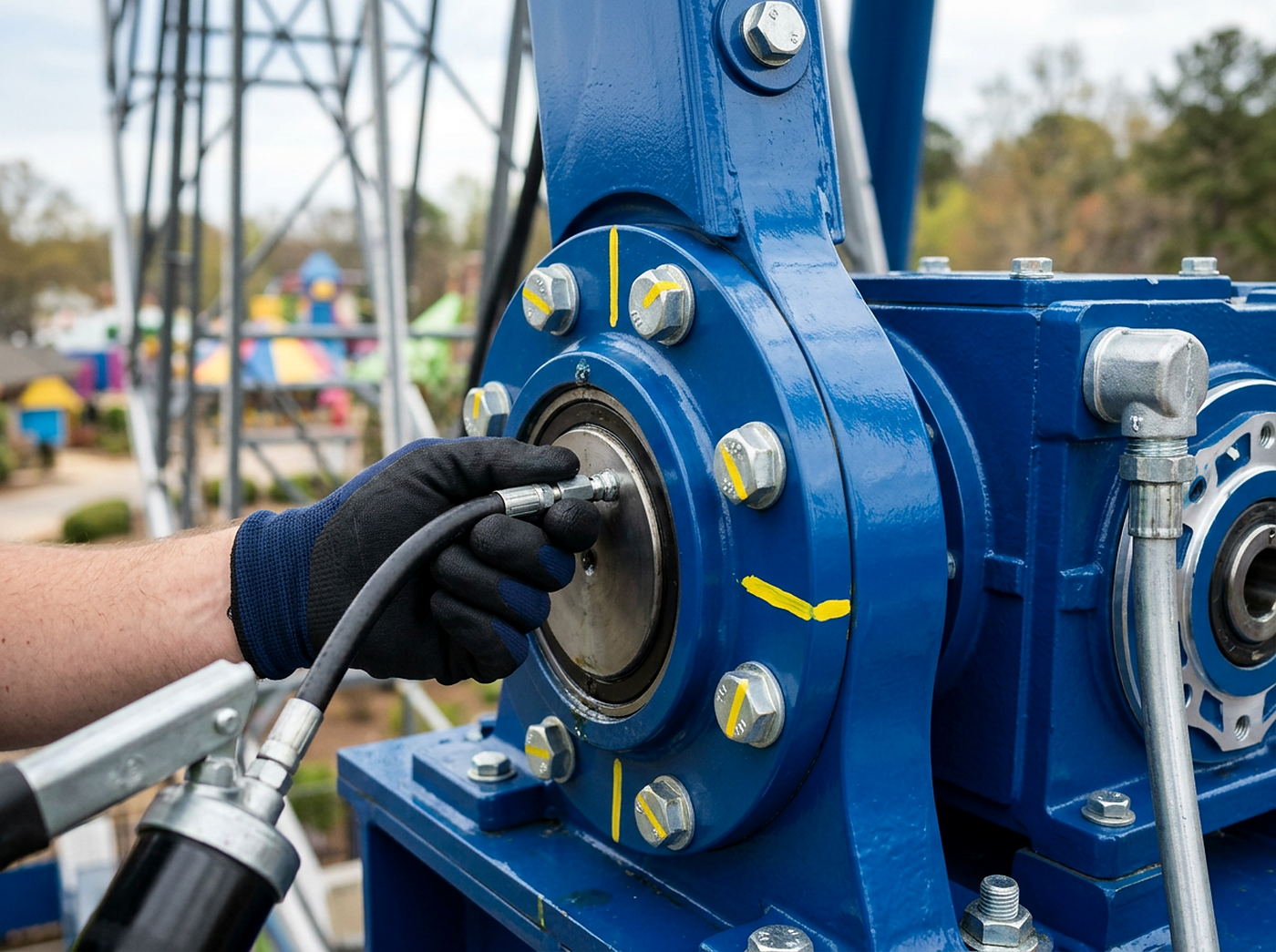
- Main bearing inspection, greasing and eventual replacement — the single largest mechanical line item over a multi-year horizon.
- Drive train: gearbox oil analysis and changes, motor checks, coupling alignment, brake adjustment and pad replacement.
- Rim, spokes and spoke cables: tension checks, corrosion inspection, touch-up painting and, on some designs, cable replacement at defined intervals.
- Cabin hangers and pivot bearings: torque verification, wear inspection, bearing replacement on condition.
- Foundation and anchor bolts: visual inspection and torque checks, usually annual.
Electrical, control and safety systems
- Control cabinet inspection, contactor and relay replacement, PLC battery and backup checks.
- Emergency drive and rescue system testing — required at defined intervals and best budgeted as a fixed annual item.
- Cabin door interlocks, restraint sensors and communication systems.
- Lighting: LED module replacement and cable inspection on the rim and spokes.
- Earthing and insulation resistance testing.
Electrical and control work is often underestimated in early budgets. It is labor-intensive rather than parts-intensive, and it requires technicians who are comfortable with the specific control platform. If your local team does not have that skill set, budget for specialist visits or a remote-support arrangement.
Labor, inspection and downtime
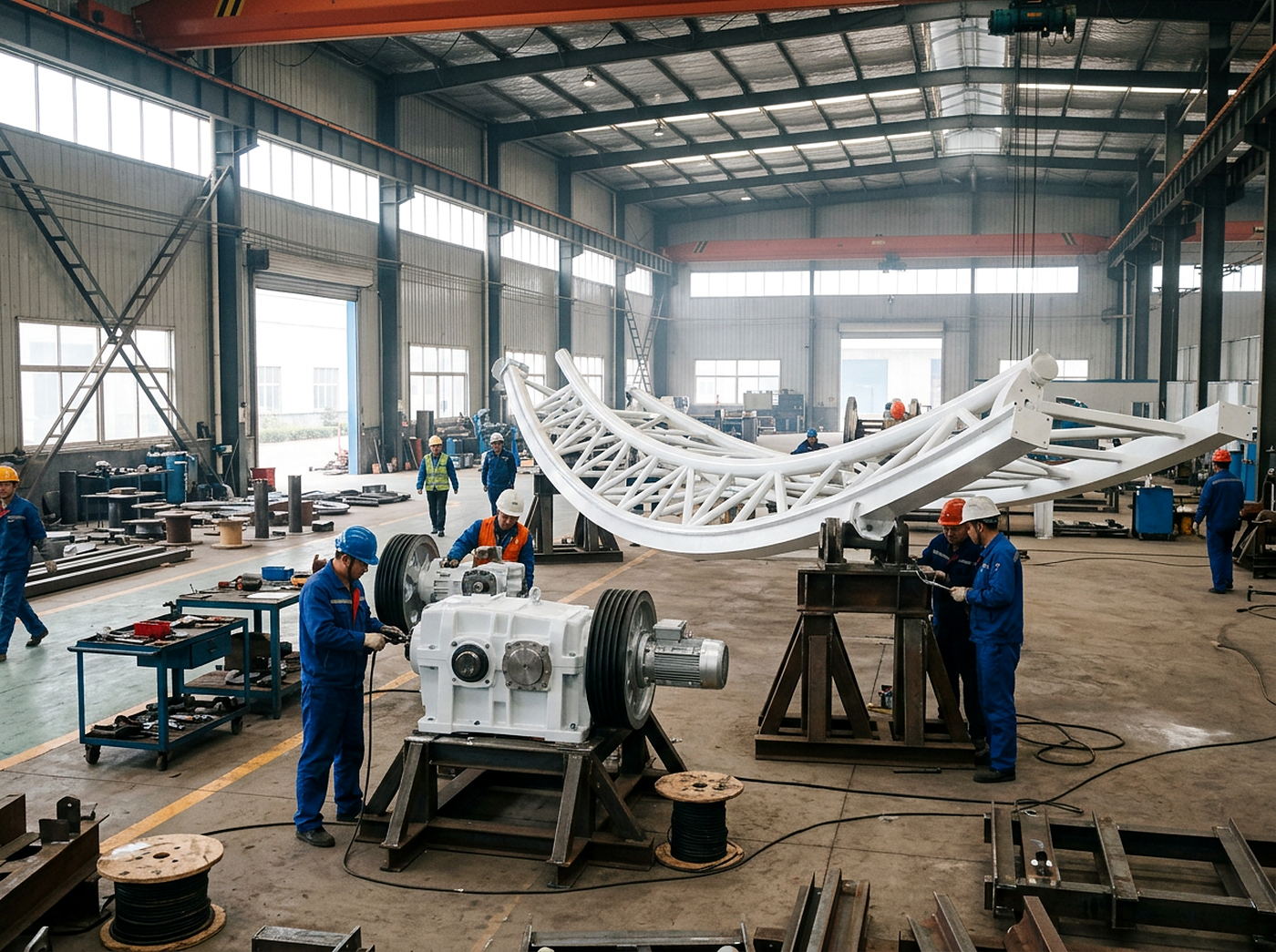
Labor is usually the largest single component of the annual ferris wheel maintenance cost, and it is the component that varies most between markets. Two models are common. In-house maintenance with a small permanent team plus specialist support for annual inspection and NDT; or a full service agreement with the manufacturer or a regional partner. In-house is cheaper on paper but requires training, tooling and documentation discipline. A service agreement costs more per year but transfers inspection liability and keeps spares and procedures current.
Downtime has a cost too, and it belongs in the budget even though it is not an invoice line. A wheel out of service for a week during peak season loses ticket revenue and disrupts school and tour bookings. Scheduling heavy maintenance in low season, and holding critical spares on site, is usually cheaper than expediting parts during peak. For a structured view of what a service program includes, see the ZhipaoRides service and maintenance support page.
Spare parts strategy
Parts costs depend on what you hold and what you order. A practical approach is to split spares into three tiers:
- Consumables held on site: lubricants, seals, brake pads, filters, lamps, fuses and fasteners.
- Critical spares held on site or at a regional depot: drive components, a cabin door interlock set, a control module, and a spare cabin hanger bearing set.
- Long-lead items ordered on condition: main bearing, gearbox, large structural sections and cabin assemblies.
Tier 1 and Tier 2 are annual budget items. Tier 3 should be planned against inspection findings and a multi-year replacement forecast, not treated as a surprise. Ask any supplier for a recommended spares list with lead times before you sign, and check that the list matches the actual configuration of your wheel.
How wheel size and configuration change the number
A larger observation wheel does not simply cost proportionally more to maintain. Cost scales with the number of cabins, the number of drive units, the height and access difficulty, and the complexity of the control and rescue systems. A 42 m wheel with a moderate cabin count is a different maintenance profile from a very large wheel with many cabins and a long ride cycle. Access matters as much as size: a wheel with good internal access to the rim and hub takes less time per inspection than one that requires rope access or crane support.
If you are budgeting around a mid-size observation wheel, the 42 m ferris wheel product page gives the configuration details — cabin count, drive arrangement and structural layout — that determine most of the recurring cost. Use those details to ask specific questions rather than generic ones.
Building the annual budget: a step-by-step method
- Define operating days and hours. Maintenance intervals are usually specified in operating hours or cycles, not calendar time. A seasonal park and a year-round park need different budgets for the same wheel.
- List every scheduled task from the maintenance manual. Include daily, weekly, monthly, quarterly and annual tasks, and note which require specialist tools or certification.
- Price labor hours by task. Multiply by your local labor rate, then add specialist visits for NDT, electrical and rescue-system testing.
- Add consumables and Tier 1–2 spares. Use the supplier's recommended spares list and your own operating history if you already run similar rides.
- Add a contingency for condition-based work. Base it on inspection findings from the first year, then adjust. A new wheel typically has a low contingency in year one and higher in years three to five as components reach replacement intervals.
- Add downtime allowance. Estimate lost revenue for planned maintenance days and hold a separate reserve for unplanned stoppages.
- Review annually against actual spend. A budget that is never reconciled against invoices will drift.
What to ask a supplier before you commit
When comparing proposals, ask each supplier for the same four documents: the full maintenance manual with task intervals, a recommended spares list with lead times, the inspection and NDT schedule with acceptance criteria, and a training plan for your in-house team. ZhipaoRides manufactures in Xingtai, Hebei, and can supply these documents against a specific model and configuration. The company's service team can also quote a supervised first-year program so your staff learn the wheel while the warranty is active.
Do not accept a single annual maintenance figure without the task list behind it. A low number that omits annual NDT, rescue-system testing or main bearing service is not a lower cost — it is a deferred cost with interest. The useful comparison is cost per operating hour over a five-year horizon, with the same task scope in every proposal.
Next step: request a scoped quotation
To turn this framework into a number for your site, send ZhipaoRides your intended wheel model or diameter, expected operating days per year, site climate and whether you plan in-house or contracted maintenance. The response should be a scoped maintenance quotation that lists tasks, intervals, labor hours, spares and exclusions, so you can compare it line by line with other options and build it into your operating budget.