
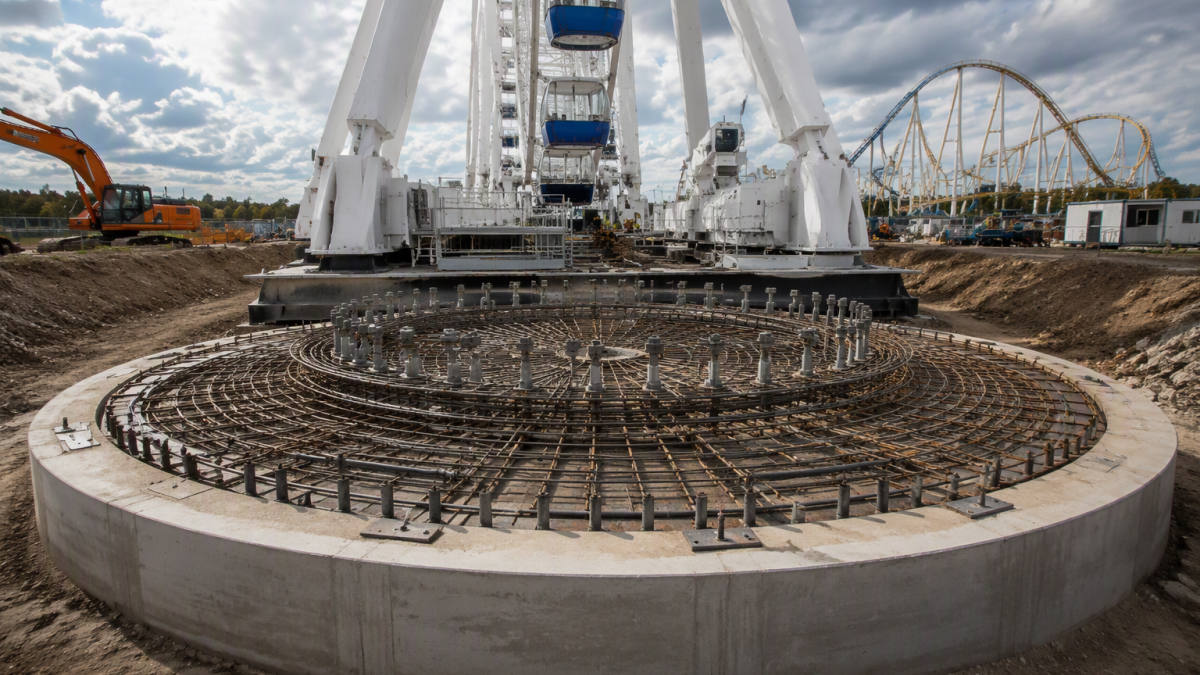
Before signing a Ferris wheel contract, buyers should budget for far more than the ride itself: site investigation, a reinforced concrete foundation designed to the wheel's actual load case, anchor and embed procurement, drainage, power and data trenching, erection crane hardstanding, and the inspection and reinstatement work that follows commissioning. These civil items are typically specified by the ride manufacturer but executed by a local contractor, which means they sit outside the equipment price and are easy to underestimate. The reliable way to control them is to obtain a foundation load package from the wheel supplier early, have a local structural engineer adapt it to site conditions, and price the civil scope against a written checklist before the contract is signed. Standards such as ASTM F2291 and EN 13814 should be referenced only as to be confirmed per project, since the applicable edition and local building code vary by market.
Why the foundation is a separate procurement package
A Ferris wheel is a structure with a rotating mass, and its foundation is not a generic slab. The manufacturer designs the ride to a defined set of reactions at the base; the buyer's civil engineer designs the concrete and reinforcement to resist those reactions in the actual soil. This split of responsibility is normal, but it creates a budgeting gap: the ride quotation usually states the reactions and interface requirements, while the excavation, concrete, rebar, formwork, anchor cages and backfill appear in a separate civil contract.
Buyers should insist that the equipment contract clearly defines the interface. At minimum, the supplier should provide foundation reaction loads for every load case, including operating, wind, seismic where relevant, braking and emergency stop, plus the anchor bolt layout, embedment details, grout requirements and permitted concrete strength at erection. Without that package, a local designer will either over-design conservatively, which raises cost, or make assumptions that later require redesign. Ask for the package as a contractual deliverable with a defined issue date, because it drives the civil programme.
For a modular wheel, the civil scope is smaller but not trivial. A 32 m modular wheel, for example, ships in about six containers and can be installed in roughly twelve days, but it still requires a level, load-rated base with correct anchor positions and a hardstanding for the erection crane. Buyers sometimes assume modular means foundation-free; it does not.
The site investigation you must commission first
No credible foundation price exists before ground conditions are known. A geotechnical investigation is the buyer's cost and should be commissioned before contract signature, not after. The scope should match the structure: boreholes or test pits to a depth below the influence zone of the foundation, standard penetration or cone penetration testing, groundwater observations, and laboratory testing of strength and compressibility. For a large observation wheel, differential settlement matters as much as bearing capacity, because the rim and cabins must remain aligned through the rotation.
Several site conditions routinely change the civil budget after investigation:
- Fill or soft ground requiring excavation and replacement, or a piled foundation instead of spread footings.
- High groundwater requiring dewatering during construction and possibly a permanent waterproofing or tanking detail.
- Rock requiring breaking or blasting, with cost and permitting implications.
- Sloping or constrained sites requiring retaining structures, stepped foundations or additional earthworks.
- Adjacent services or structures requiring temporary support, monitoring or protective works.
Each of these is a legitimate variation that a buyer should carry as a risk allowance in the budget rather than discover mid-construction.
What the civil scope actually includes: a budgeting checklist
The most common cause of overrun is an incomplete scope definition. The table below lists the items that should appear in every Ferris wheel civil budget, with the party normally responsible. Responsibility splits vary by contract, so confirm each line in writing.
| Scope item | Typical responsibility | Budget note |
|---|---|---|
| Geotechnical investigation and report | Buyer | Commission before signing; scope to foundation depth |
| Foundation design and structural calculations | Buyer's engineer, using supplier load package | Allow for local code review and stamped drawings |
| Excavation, dewatering, disposal of spoil | Buyer's civil contractor | Highly site-dependent; price after investigation |
| Reinforcement, formwork, concrete, curing | Buyer's civil contractor | Include concrete strength and testing requirements |
| Anchor bolts, embed plates, grout | Usually supplier, sometimes buyer | Confirm who supplies and who sets; setting tolerance is critical |
| Erection crane pad and access route | Buyer | Ground bearing capacity must suit the crane |
| Drainage and surface water management | Buyer | Protect foundation and electrical pits from standing water |
| Power supply, earthing, data conduit | Buyer to supplier interface | Confirm capacity, route and termination point |
| Perimeter fencing, queue and platform civils | Buyer | Often omitted from early budgets |
| Reinstatement, paving and landscaping | Buyer | Allow for crane damage and trench reinstatement |
A second checklist should cover documentation: approved foundation drawings, concrete test records, anchor bolt survey records, earthing test results and as-built drawings. These are needed for commissioning and for the authority having jurisdiction, and they cost money to produce and collate.
Loads, tolerances and the details that drive cost
Foundation cost is driven less by the wheel's diameter than by the load cases and tolerances the design must satisfy. Buyers should expect the supplier's load package to distinguish permanent, variable, wind and seismic actions, and to state whether the wheel is designed to remain operable in defined wind speeds or to be parked in a specified storm condition. The parked condition often governs the foundation, because an unoccupied wheel presents a large sail area.
Anchor bolt setting tolerance is another cost driver. If the embedment positions are wrong, remedial work is expensive and can delay erection. Specify a survey of anchor positions before concrete pour and again after curing, and hold the supplier's setting templates on site. Grout strength and the sequence of bolt tensioning should also be defined.
For large observation wheels, the interface between the foundation and the wheel support structure deserves particular attention. An 88–89 m observation wheel with 42–49 cabins requires a foundation designed for substantial overturning moments, and the connection details between the steel support legs and the concrete must be coordinated early. Hot-dip galvanized steel structures reduce long-term maintenance, but the galvanizing thickness and the contact detail at the concrete interface still need design attention to avoid corrosion at the base.
Electrical and control civils are frequently underestimated. Remote diagnostics support requires a reliable data connection to the control system, which means conduit, cabinets and a protected power supply. These items should be on the civil drawing set, not left to the electrical contractor to improvise after the wheel is erected.
Programme, risk and contract terms to agree before signing
Civil works sit on the critical path. Concrete must reach its specified strength before erection, and curing time cannot be compressed without changing the mix design and obtaining engineering approval. Buyers should therefore agree a programme that sequences investigation, foundation design approval, construction, curing, erection and commissioning, with defined hold points.
Contract terms should allocate risk explicitly. Recommended provisions include: a supplier obligation to issue the foundation load package by a stated date; a buyer obligation to complete the foundation and provide survey records before mobilisation; a defined process for design changes; and a clear statement of which standards apply, referenced as to be confirmed per project. Where the supplier offers engineering support for the foundation interface, define its scope and deliverables in the contract rather than relying on informal assistance.
Finally, budget a contingency. Ground conditions, authority requirements and crane access are the three items most likely to vary, and a contingency held against the civil package is cheaper than a variation raised during construction. Buyers who want to compare wheel configurations and understand the interface requirements for different product types can review the range at ZhipaoRides products, and should request the foundation load package as part of any technical proposal. Getting the civil scope right before signature is the single most effective way to protect the project budget.